Plan Your Modern Data Management Strategy: Part One — Strategy
We’ve put together a handful of activities to guide your organization in the data transformation process, including data transformation tools you can use.
Standardize how AI agents are governed, operated, and improved.
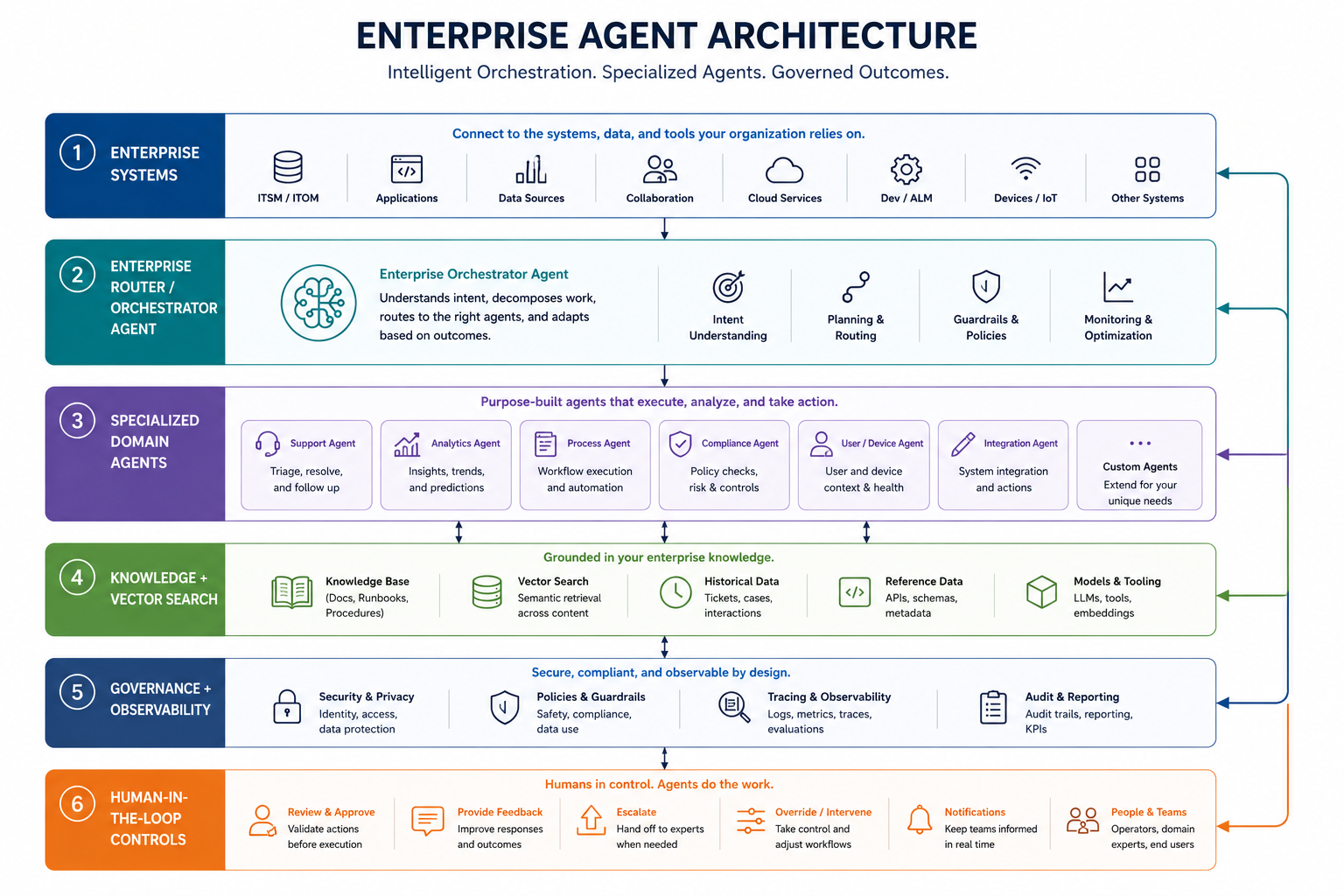
Building an AI agent is only the beginning. As agents move into production, organizations need consistent standards for how they are observed, evaluated, changed, secured, supervised, and improved. 27Global implements the shared AgentOps capabilities that turn project-specific controls into a repeatable operating model across your whole agent estate.
AgentOps is the discipline of governing and operating production AI agents. It is distinct from traditional AIOps, which applies AI to IT operations. The two are often confused, and the distinction matters: one applies AI to your infrastructure, the other governs the AI itself.
Production agents introduce operational questions that ordinary application monitoring cannot answer. Can you reconstruct an agent run across model calls, tools, retries, asynchronous steps, and human decisions? Is the agent still completing its intended task safely and within its service objectives? Can a proposed change pass repeatable quality, safety, authorization, and cost checks before release? Are tool permissions, data access, memory, and side effects controlled across the agent lifecycle? Do your oversight teams have actionable queues, escalation paths, evidence, and the authority to intervene?
Without a common operating standard, every agent team invents its own telemetry, evaluation thresholds, release process, and evidence trail. That inconsistency becomes an enterprise reliability and governance risk.
Standardized instrumentation, telemetry, service objectives, dashboards, alerts, run correlation, and incident diagnostics across every agent workflow.
Versioned evaluation datasets, deterministic and model-based evaluators, release gates, production sampling, and regression analysis.
Traceable release bundles covering code, prompts, models, tools, permissions, retrieval, memory, guardrails, evaluations, and routing — with benchmark-based cost controls.
Review queues, escalation paths, intervention procedures, decision records, workload measures, and oversight-effectiveness reviews.
Led by the OWASP Top 10 for Agentic Applications 2026: least-privilege tool access, policy enforcement, typed inputs and outputs, data and memory protections, adversarial testing, and security response integration.
Ownership, lifecycle decisions, risk and incident reporting, control evidence, improvement backlogs, and an operational review cadence that holds.
A current-state AgentOps maturity and risk baseline, then a target model with roles, decision rights, and service ownership.
A version-pinned OpenTelemetry-based standard, plus an agent inventory, dependency map, and approved tool and MCP inventory.
Dashboards, alerts, service objectives, and incident-response runbooks that work across teams and platforms.
Versioned evaluation suites, risk-based release gates, a governed release bundle, and a rollback or suspension procedure.
An evidence map supporting NIST AI RMF, EU AI Act, and ISO/IEC 42001 alignment, an operational acceptance scorecard, and a prioritized improvement backlog.
AI Agent Factory builds agents and use-case controls; AgentOps implements the shared estate standards and continuous improvement around them. Enterprise Data Platform provides governed data and lineage; AgentOps relates data quality to agent behavior. AI-Ready Cloud Transformation provides infrastructure reliability and FinOps; AgentOps adds agent-level signals. Agent-Native App Modernization exposes governed tools; AgentOps monitors their use. AI Enterprise Architecture defines the control-plane standards; AgentOps implements and operates the operational portions.
Managed AgentOps, or the next improvement and use-case cycle.
For one or two agents approaching production. Establishes operational acceptance and a clean transition, commonly following an agent delivery engagement.
For existing production agents with fragmented or incomplete operational controls. Baselines the estate and closes the highest-risk gaps first.
For multiple teams or platforms that need one shared governing standard rather than several local conventions.
Ongoing client-operated, co-managed, or managed improvement after implementation. Scope, support windows, response targets, and ownership are contractual.
Scope and investment are confirmed after discovery, based on agent count, autonomy level, risk classification, platforms, integrations, and the controls you already have.
Compliance obligations, evidence retention, immutable storage, and review requirements are tailored to your systems, role, risk classification, and legal guidance. This service supports compliance and audit readiness. It does not guarantee certification or legal compliance.
AgentOps begins during production-readiness planning, not only after launch. It can also enter directly to remediate agents that are already live and already causing concern.
We implement against NIST AI RMF, OpenTelemetry GenAI semantic conventions, the OWASP Agentic Top 10, the EU AI Act, and ISO/IEC 42001 — then select tooling to fit.
The instrumentation, evaluation, and release patterns we implement are the ones running against our own production agents on AWS and Azure.
OpenTelemetry instrumentation with MLflow, Langfuse, or Arize as the backend. Your traces are not locked into a platform decision made in month one.
No tier implies 24x7 support, infrastructure ownership, or compliance certification unless explicitly contracted. What we commit to is written down.
The outcome is a repeatable AgentOps governance standard: measurable reliability, controlled change, effective oversight, continuous security assurance, and evidence-based improvement across the estate.
Contact us today
The latest news, advancements and trends in software development.
We’ve put together a handful of activities to guide your organization in the data transformation process, including data transformation tools you can use.
The Discovery phase is focused on several activities that will identify all current data-related elements and map the flow of data throughout its lifecycle.