Plan Your Modern Data Management Strategy: Part One — Strategy
We’ve put together a handful of activities to guide your organization in the data transformation process, including data transformation tools you can use.
Build the cloud your AI strategy requires — in 6 to 24 weeks.
Most cloud migrations optimize for application hosting. AI agents need something different: approved private model endpoints, workload-appropriate compute, low-latency connectivity, attributable usage, and governed access. 27Global builds the cloud foundation your AI strategy actually requires — not the infrastructure your AI projects are currently working around.
The Nutanix Enterprise Cloud Index found 82% of IT leaders say their infrastructure isn’t ready for AI workloads, and Cisco reports 54% of organizations say their networks can’t scale to current AI complexity. Meanwhile 83% of data migration projects fail or significantly exceed budget, and enterprises waste 21% of cloud spend — roughly $44.5B globally — on unused resources.
Standard cloud migrations don’t solve these problems because they were never designed for AI workloads. Multi-step agents generate variable model, tool, storage, and compute consumption. Without infrastructure allocation and agent-level correlation in place first, the cost is discovered only after production usage grows.
Most organizations are running AI on infrastructure built for applications. That is the gap we close.
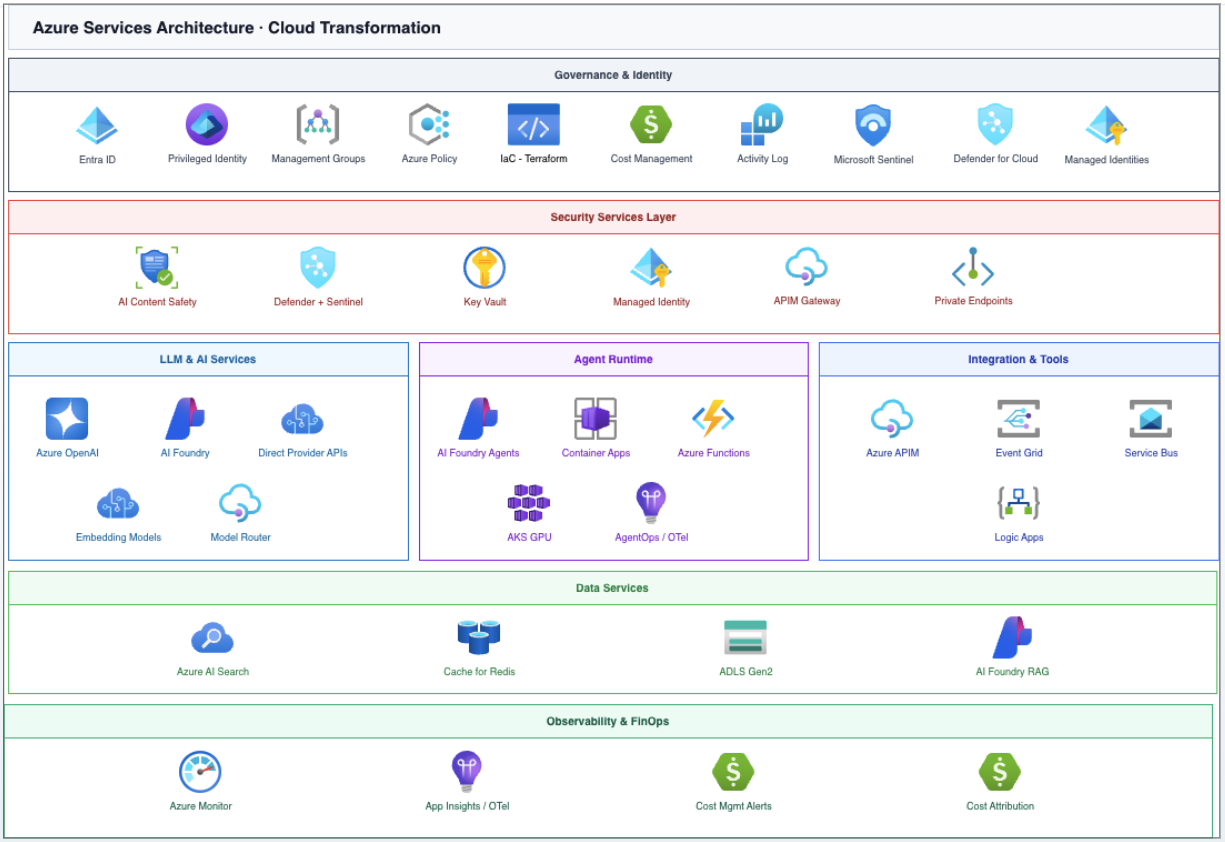
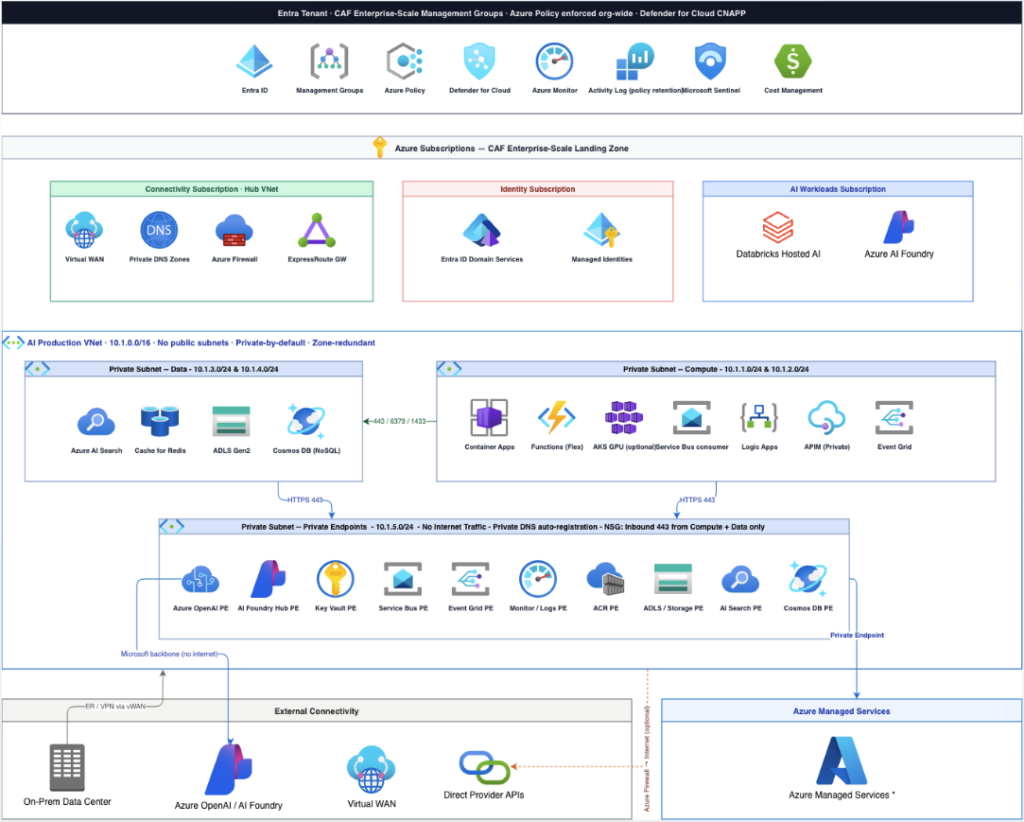
Private connectivity to Bedrock or Azure AI Foundry where supported and required, replacing unapproved public model endpoint access.
GPU-accessible subnets with P4, P5, or Trainium on AWS and ND H100 on Azure, instead of general-purpose instances that throttle under inference load.
Private network, compute, and storage primitives for approved vector and retrieval services, rather than retrieval running wherever it landed first.
Workload identities scoped by deployable workload and trust boundary, replacing shared service credentials that make lateral movement trivial.
Resource and endpoint allocation tags, model-endpoint usage exports, and GPU idle detection, so cost is attributable before it becomes a surprise.
Dashboards for endpoint health, capacity, throttling, infrastructure latency, and cloud cost — well beyond what default monitoring provides.
Approved model connectivity, workload-appropriate compute, retrieval hosting primitives, Zero Trust network controls, and SSO.
Terraform by default, or CDK or Bicep where your standards require it. Versioned, documented, and runnable by your team.
Tagging, workload allocation, budget alerts, GPU idle detection, chargeback and showback, and a review cadence that survives us leaving.
CSPM remediation status, NIST CSF 2.0 control mapping, and named evidence gaps against your applicable requirements.
On-call playbooks, architecture decision records, and an onboarding guide for the platform team.
Agent quality evaluation, agent release governance, human-oversight operations, and cross-agent operating policy are owned elsewhere. We build and operate the platform beneath them.
AI Agent Factory, Enterprise Data Platform, and Agent-Native App Modernization deploy workloads onto this foundation. AgentOps Governance correlates infrastructure health and allocated cost with agent outcomes.
Inventory workloads, map dependencies, baseline performance and cost, and identify the regulatory constraints with infrastructure implications.
Network topology, model connectivity, compute selection, identity model, and security controls designed against your actual AI roadmap.
Landing zone implemented in version-controlled Terraform, CDK, or Bicep, with the pipeline your team will use to extend it.
Workloads migrated in waves, validated against the performance baseline, with integration tests passing and rollback documented.
Tagging enforced, allocation reporting live, budgets and GPU idle detection active, and AI workload dashboards in place.
CSPM remediation, NIST CSF 2.0 control mapping, on-call playbooks, architecture decision records, and team enablement.
98% of FinOps teams now manage AI spend, up from 31% two years ago. We implement the tags, allocation data, usage exports, budgets, and GPU controls before agents scale — not after the first alarming invoice.
Private model endpoints, GPU-capable subnets, and retrieval hosting primitives are design inputs, not change requests filed six months after the migration completes.
Agentic workflows add variable model, tool, storage, and compute consumption. Allocation and attribution go in before production usage grows, when they still cost nothing to add.
AI workloads amplify familiar cloud failures. Public endpoints widen exposure, unscoped workload identities enable lateral movement, and indiscriminate prompt logging leaks sensitive data.
Everything ships as version-controlled infrastructure as code with runbooks and enablement. No dependency on us to make a routine change.
Every AI-ready landing zone includes CSPM activation, a Zero Trust network model, and managed AI-safety integration where required. Use-case controls are defined during agent delivery; ongoing testing and operations transition into AgentOps Governance.
Contact us today
The latest news, advancements and trends in software development.

We’ve put together a handful of activities to guide your organization in the data transformation process, including data transformation tools you can use.


The Discovery phase is focused on several activities that will identify all current data-related elements and map the flow of data throughout its lifecycle.