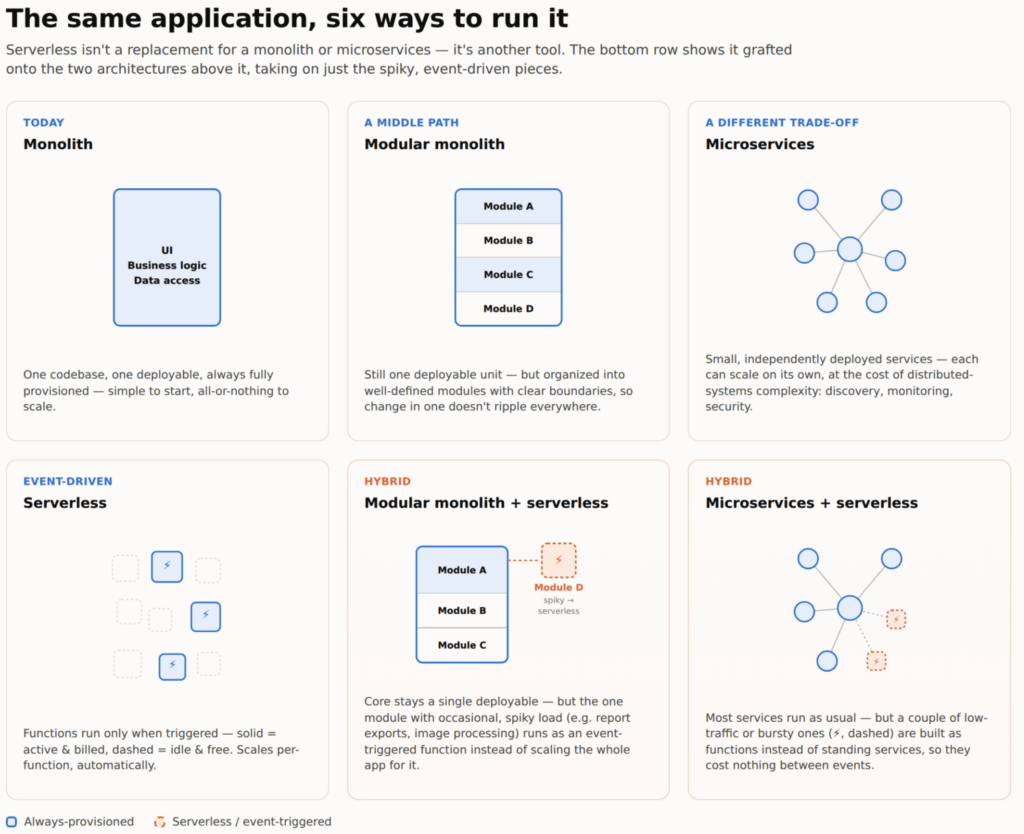
Many applications are built as a monolithic application where the UI, business logic and data access layers are developed and deployed as a single unit. While the simplicity is a big draw, as the business grows, the hidden costs of maintaining a monolith often grow with it.
The question is not whether monolithic applications are good or bad, but is it costing more than it should?
THE HIDDEN COST OF A MONOLITH
The Always-On, Peak-Ready Infrastructure
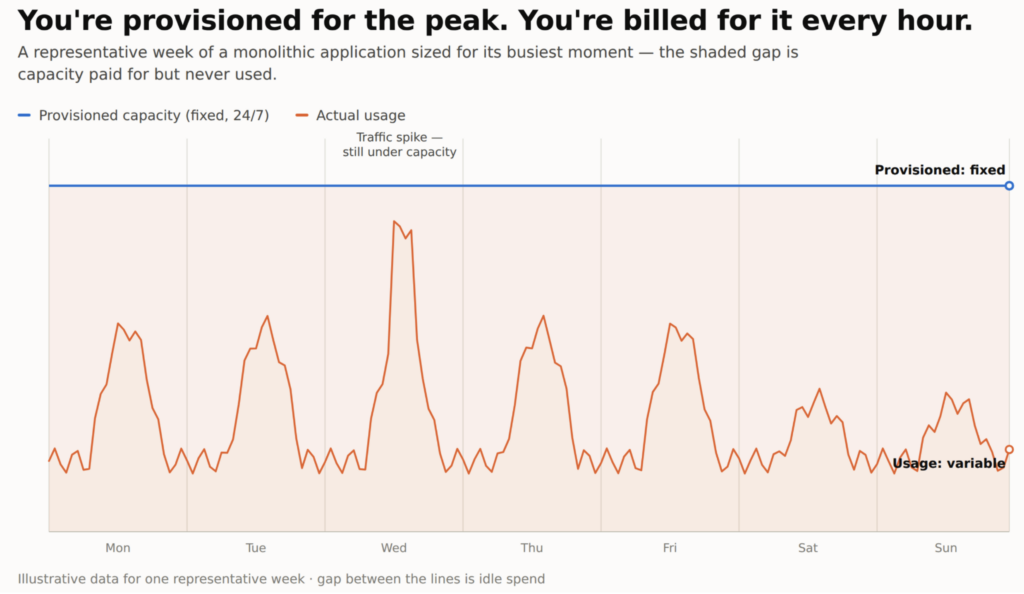
Most monolithic applications run on dedicated servers, virtual machines, or containers that stay online 24/7. Whether your application is handling thousands of requests or sitting idle overnight, you’re still paying for the underlying infrastructure.
This can lead to:
- Paying for idle compute resources
- Over-provisioning servers to handle occasional traffic spikes
- Scaling the entire application when only one feature needs more capacity
- Ongoing infrastructure management and maintenance.
Productivity and Opportunity Loss
The cost of a traditional monolithic application is not limited to infrastructure or maintenance, but it also shows up in the opportunities your organization misses. When the team spends significant time navigating complexity of longer development cycles and coordinating releases, fewer resources are available to deliver new features, implement new technology and respond to market changes.
Individually, these issues may seem manageable. Together, they can significantly impact productivity and operating costs.
IS MICROSERVICE ARCHITECTURE THE ANSWER?
Not always. Microservice architecture, which breaks an application into a collection of small, independent services, introduces a different set of challenges associated with distributed systems, service discovery, monitoring, security, and operational complexity.
Many organizations find that a modular monolith provides the right balance between simplicity and scalability. A modular monolith remains a single deployable application, but its functionality is organized into well-defined, self-contained modules, each with clear responsibilities and minimal dependencies on other parts of the system. This structure makes the codebase easier to understand, test, and maintain while reducing the ripple effects of changes.
HOW SERVERLESS CAN HELP
Serverless computing takes a different approach. Instead of running an entire application continuously, individual functions execute only when triggered by an event. The cloud provider automatically provisions and scales the infrastructure, and you pay only for the compute resources your code actually uses.
Not every application is a good candidate for serverless, but many supporting event-driven workloads are often ideal candidates. Rather than scaling an entire application because one feature experiences occasional spikes, these workloads can scale independently and incur little to no cost when idle.
Serverless isn’t a replacement for monoliths or microservices. Rather, it’s another architectural tool. Used strategically, it can reduce infrastructure costs while allowing development teams to focus on delivering business value instead of managing servers.
WHERE TO GO FROM HERE
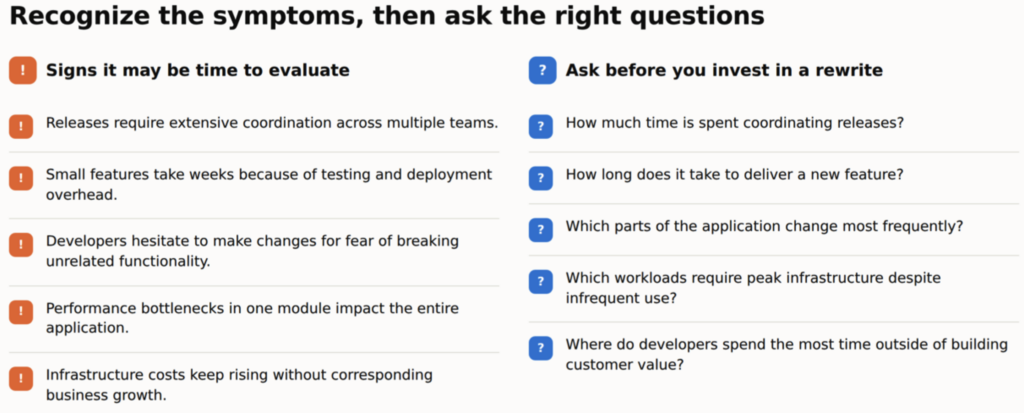
If you recognize these patterns, it may be time to evaluate your architecture:
- Releases require extensive coordination across multiple teams.
- Small features take weeks because of testing and deployment overhead.
- Developers are hesitant to make changes for fear of breaking unrelated functionality.
- Performance bottlenecks in one module impact the entire application.
- Infrastructure costs continue to rise without corresponding business growth.
But before investing in a major architectural change, understand where your costs actually originate by asking questions such as:
- How much time is spent coordinating releases?
- How long does it take to deliver a new feature?
- Which parts of the application change most frequently?
- Which workloads require peak infrastructure despite infrequent use?
- Where do developers spend the most time outside of building customer value?
More often than not, the greatest return comes not from rewriting your application, but from eliminating the bottlenecks that prevent your teams from delivering value.
A monolithic application isn’t something you need to replace simply because it’s been around for years. If it continues to meet your business needs, supports your teams, and enables you to deliver value efficiently, it may still be the right architecture.
The key is recognizing when your architecture becomes a constraint rather than an enabler. Whether you choose to improve your monolith, evolve toward a modular design, adopt microservices, or leverage serverless for specific workloads, measure the investment by asking this question: “Does it help your teams deliver more value, faster?”
Technology decisions should always support business outcomes. The best architecture is the one that enables your organization to innovate, respond to change, and serve your clients effectively.