
Plan Your Modern Data Management Strategy: Part One — Strategy
We’ve put together a handful of activities to guide your organization in the data transformation process, including data transformation tools you can use.
Know before you build. An independent AI readiness baseline in two to four weeks.
Every organization with an AI mandate faces the same pressure: leadership wants agents in production, but the honest answer to “are we ready?” is unclear. 27Global gives you that answer independently, across nine dimensions, in two to four weeks — with a prioritized use-case portfolio, a costed multi-track roadmap, and a readout deck you can take straight to your board.
The most common reason AI projects fail is not the model. It is skipping the structured evaluation of what is actually in place before development starts.
Roughly 80% of AI projects fail to meet expectations, and Cloudera and Harvard Business Review found only 7% of enterprises consider their data completely ready for AI. The pattern in the failures is consistent: 89% of failed AI projects never conducted a formal data readiness assessment. Projects that do run one succeed at 47%, against 14% for those that don’t.
Assessment is not overhead. It is the single highest-leverage two weeks in an AI program.
Executive sponsorship, budget commitment, success metrics, and a scored inventory of candidate use cases ranked by impact, feasibility, and data readiness.
Quality, discoverability, accessibility, PII controls, and governance model — including the lakehouse-to-agent-ready gap that standard data audits miss entirely.
Cloud maturity, resilience and disaster recovery, network capacity, MLOps tooling, and agent-tool readiness: do your core systems expose APIs, and are they protected by OAuth or only static keys?
EU AI Act posture, NIST AI RMF alignment, and ISO/IEC 42001 readiness, with the specific compliance gaps named rather than gestured at.
AI and data engineering depth, leadership AI literacy, organizational resistance, and change management capability.
Tracing, evaluation pipeline, cost attribution, drift monitoring, and alerting. The question is not whether you can build an agent — it is whether you can operate one.
Nine-dimension maturity score from 1 to 5, with peer benchmarking.
Five to ten prioritized use cases with ROI estimates and readiness gaps mapped against each.
The specific gaps blocking your highest-priority use cases, with remediation options.
EU AI Act, NIST AI RMF, and ISO 42001 posture with named compliance gaps.
A multi-track plan across data, cloud, tooling, and agent delivery — costed and sequenced by workstream.
We do not implement the recommended architecture or controls inside this engagement. Keeping assessment separate from implementation is what makes the findings credible.
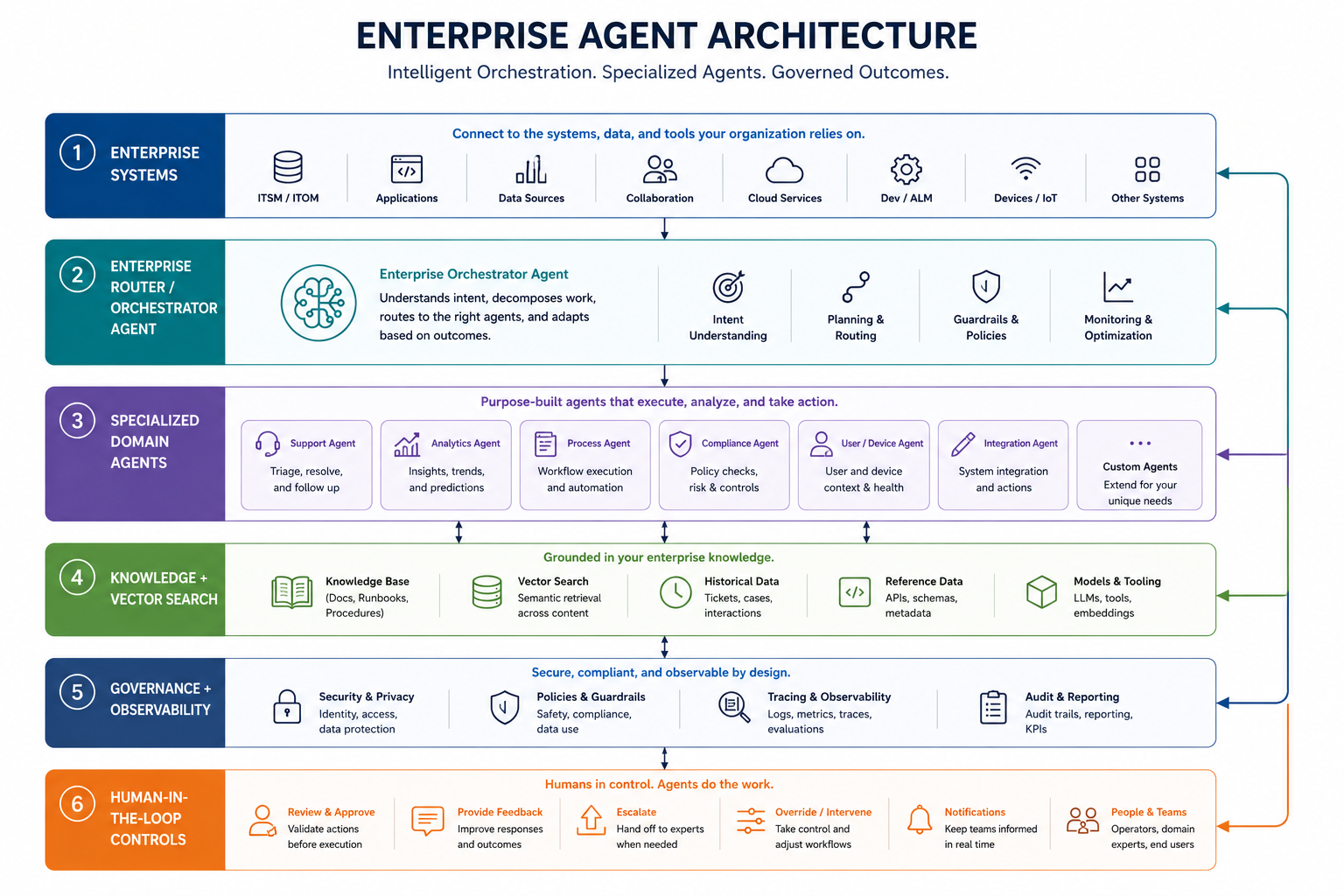
Findings route by evidence, not by default. Data gaps go to Enterprise Data Platform, infrastructure gaps to AI-Ready Cloud Transformation, API and tool gaps to Agent-Native App Modernization, and validated use cases to AI Agent Factory.
Agree the business units in scope, identify the people we need access to, and set the evidence standard for each dimension.
Structured sessions with business, engineering, data, security, and compliance stakeholders — not a questionnaire emailed to a distribution list.
Hands-on review of cloud configuration, data platform, integration surfaces, identity model, and existing observability tooling.
Candidate use cases evaluated on business impact, technical feasibility, and the specific data and system dependencies each one carries.
Findings consolidated into a maturity score, a named gap list, and a sequenced multi-track roadmap with investment per workstream.
A board-ready presentation delivered live, with the detailed findings pack handed over for internal use.
Cloud provider readiness assessments output an adoption roadmap for that provider’s platform. That is not an assessment — it is a sales motion with a scorecard attached. We evaluate what you actually have.
We assess across AWS, Azure, Databricks, open source, and on-premises, and recommend the path that fits your environment rather than the one that pays us.
The finding we surface most often: data and governance look ready, but core systems expose APIs protected only by static keys, so agents have nothing they can safely call.
EU AI Act enterprise enforcement begins August 2026, with penalties up to 30M euro or 6% of global revenue. We surface exposure now, while it is still cheap to fix.
We can execute the roadmap we deliver. You are not re-onboarding a second firm and re-explaining your environment from scratch.
Only 13% of organizations globally are fully AI-ready, and just 27% of boards have formally put AI governance into a committee charter. An independent baseline now is what separates a funded program from a stalled one.
Contact us today
The latest news, advancements and trends in software development.

We’ve put together a handful of activities to guide your organization in the data transformation process, including data transformation tools you can use.


The Discovery phase is focused on several activities that will identify all current data-related elements and map the flow of data throughout its lifecycle.