AI Enterprise Architecture

One architecture for your entire AI estate — before sprawl becomes debt you can’t unwind.

Your teams are already building AI agents. The problem isn’t whether they work — it’s that each one has its own platform, its own identity model, its own integrations, and no shared control plane. That isn’t an AI strategy. It’s an architecture gap that compounds every quarter. 27Global designs the target-state architecture that makes every agent you build consistent, governed, and cheaper to deliver.

You don't need another agent. You need the architecture that governs all of them.

The Salesforce Connectivity Benchmark found enterprises now deploy an average of 12 AI agents, and 94% of IT leaders say sprawl is increasing complexity and technical debt. Half of enterprise agents run in isolated silos, ungoverned. Gartner projects that 50% of agent deployment failures through 2028 will stem from governance gaps.

The economics compound the problem. Integration cost exceeds model cost by three to five times in production, and every team that builds independently rebuilds the same connectors, the same identity plumbing, and the same observability from scratch.

The enterprises that win are not the ones with the most agents. They are the ones whose agents share one governed architecture.

What we deliver

Enterprise AI reference architecture

A platform-agnostic logical model plus per-platform physical models, so the standard survives a platform decision changing.

Agent control plane design

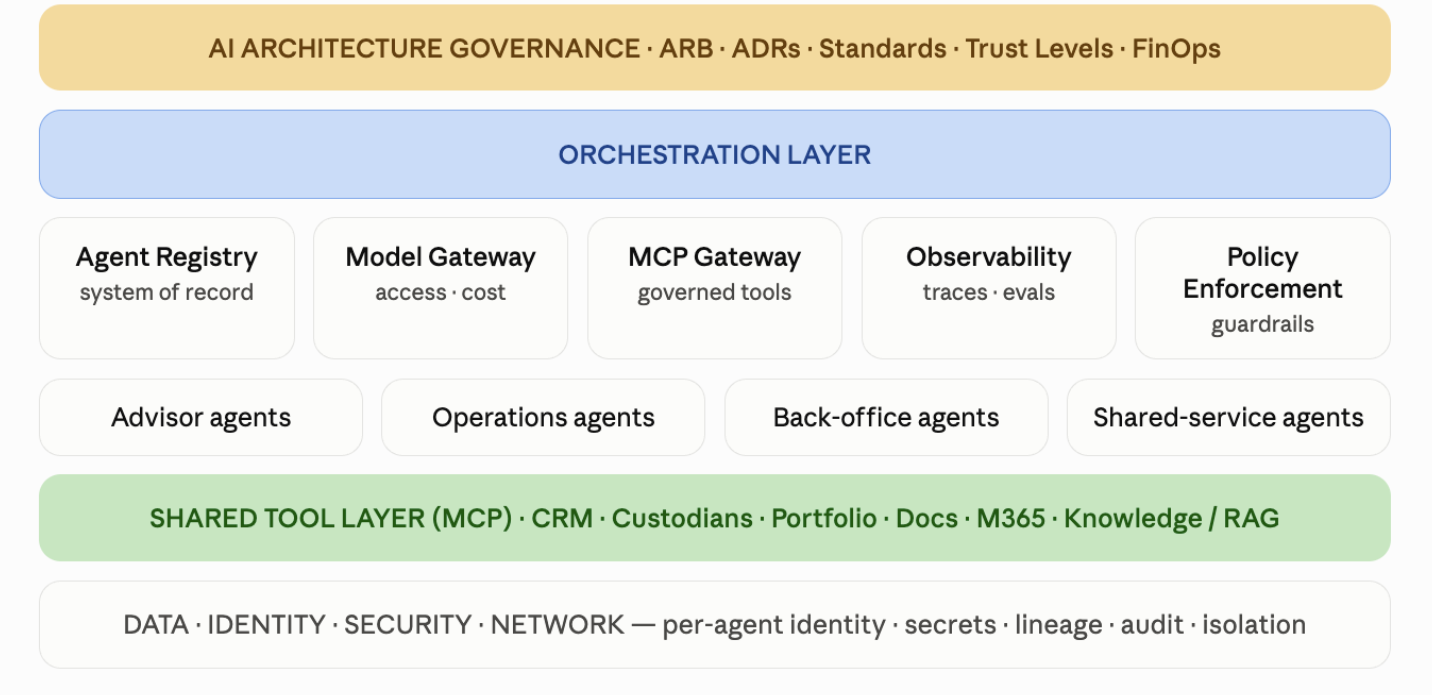
Registry, identity and RBAC, lifecycle management, federation, model and MCP gateways, an observability standard, and policy enforcement.

Identity and federation architecture

How agent identity works across agent platforms and your enterprise identity providers, including delegation and run-as-user patterns.

Platform and build-vs-buy strategy

Explicit selection criteria for single cloud, multi-cloud, or hybrid — with the reasoning documented so the decision can be revisited honestly.

Data, integration, and security blueprints

Knowledge and RAG strategy, integration bus, agent identity and secrets, guardrails, and audit architecture.

AI FinOps model

Cost attribution, budgets, model routing, and chargeback designed before spend becomes politically difficult to control.

Governance and roadmap

Architecture Review Board

An ARB charter with real decision rights, plus an exception process that people will actually use instead of route around.

Architecture decision records

An ADR process and a pattern library, so the reasoning behind a standard outlives the person who set it.

Agent-first SDLC

How agents get specified, built, reviewed, and released — including agent rules files, trust levels, and machine-readable specs.

Sequenced 12 to 24 month roadmap

Costed by wave and tied directly to the delivery engagements that implement each one.

Fractional Chief AI Architect

Ongoing advisory and ARB participation, for organizations that need the authority present without a full-time hire.

What this engagement owns

  • Enterprise reference architecture and platform strategy
  • Control-plane, identity and RBAC, federation, observability, and tool-layer standards
  • Agent lifecycle architecture, decision rights, exception process, and Architecture Review Board
  • Sequenced implementation roadmap

What sits elsewhere

This engagement defines the target state, the standards, and the decision rights. It does not deliver production agents or run ongoing agent operations — deliberately, so the architecture stays independent of any one build.

Where it goes next

AI Agent Factory, Enterprise Data Platform, AI-Ready Cloud Transformation, and Agent-Native App Modernization implement the approved target state. AgentOps Governance implements and operates its operational portions.

Delivery approach

1. Current-state discovery

Inventory the AI estate, map cloud, data, and identity, and surface the architecture debt already accumulating across teams.

2. Target-state reference architecture

Logical and per-platform models, platform strategy, build-versus-buy decisions, and the principles and standards that govern them.

3. Agent control plane and estate design

Registry, identity and RBAC, lifecycle, federation, gateways, observability standard, and the shared MCP tool layer.

4. Data, integration, and security architecture

Knowledge and RAG strategy, integration bus, security model, agent identity and secrets, and the AI FinOps model.

5. Operating model and governance

AI Architecture Review Board, ADR process, pattern library, and the agent-first SDLC your teams will work inside.

6. Roadmap and transition planning

Sequenced, costed waves tied directly to the delivery engagements that will execute them.

The 27Global Difference

Enterprise AI spending reached $37B in 2025, more than tripling from $11.5B in 2024. Gartner projects 40% of enterprise applications will embed AI agents by the end of 2026, up from under 5% in 2025. The architecture decisions being made right now will be expensive to reverse.

Architects who still build

Senior architect-led, but the same team ships production agents. The target state we design is one we know how to implement, because we implement it.

It pays for itself in prevented rework

The architecture typically pays for itself by preventing duplicated platform and integration spend across the first two or three build projects.

Genuinely platform-neutral

We architect across AWS Bedrock AgentCore, Azure AI Foundry, Databricks Mosaic AI, and open source. The platform strategy follows your constraints, not our incentives.

Standards you can enforce

An ARB charter, an ADR process, and a pattern library with real decision rights. Standards nobody can enforce are just documentation.

MCP has become the integration standard, with 97M monthly SDK downloads as of March 2026 and more than 9,400 servers in the public registry. Designing the shared tool layer once, correctly, is what keeps every subsequent agent cheap to build.

Ready to bring order to your AI estate?

One target-state architecture for every agent you build.

Contact us today

News & Blog

The latest news, advancements and trends in software development.

Interested in a career in software development?